
Validation through Oral History and Archaeology at the Choptico Town
Preface
The following is a retelling of just a small piece of the family history of Rico Newman,
an elder of the Choptico Band of the Piscataway-Conoy tribe. While it is a story
passed down from generation to generation in his family, it had only been shared with
archaeologists a little over a decade ago. When archaeologists from St. Mary’s College of
Maryland worked with tribal partners and collaborators on a Maryland Historical Trust-funded
Piscataway Landscapes survey project, Mr. Newman donated his time to lobby in
support of the project and provide critical information regarding the location of the circa
1650 Choptico Reservation and Town.
His family’s memory of the Choptico Reservation, which is not mentioned in official
records after 1712, persisted by word of mouth for generations. While common local
history had always placed the reservation on the aptly-named “Indiantown Farm,” the
precise location of the town within that nearly 900-acre parcel was unknown.
Read below, in Mr. Newman’s own words, about how fragments of that long ago history
were passed down among indigenous families who, while erased from colonial and
later archives, never left the land of their ancestors.
Forty-nine years ago, Greta Joy, my aunt and the youngest daughter of L.G. Joy and Anna L.
Wilson, had the presence of mind to interview her 97-year-old mother about our family’s past.
Greta’s interest in our history was piqued while watching the 1977 television series “Roots,”
based on the book by Alex Haley. Is it a coincidence Greta was 49 at the time she saw “Roots”?
Fortunately, Greta recorded these interview sessions. These conversations proved priceless,
providing our family with a connection to an era that might otherwise have been forgotten.
Twenty-five years ago, these tapes were played for several family members who were elated
to hear the oral histories passed down through generations.
Recording oral history can powerfully validate historical events. In this case, my grandmother recalled her own grandmother describing the details of being required to leave their home on
the Choptico Reservation for a new home. Their former property was known as “Widow’s Purchase.”
The land where my grandmother’s parents, siblings, and prior generations lived for several years after was on what is now Mt. Victoria was titled “Widow’s Dower.” The
successive naming of these locations with the word “Widow” proved prophetic and was key to affirming the historical location of the former reservation known as “Choptico Town” (Figure 1).

Validation
Armed with the knowledge of Mr. Newman’s family history of the reservation, archaeologists
were able to narrow their search. The tract Widow’s Purchase was patented to Philip Key (a
relative of Francis Scott Key) in 1796 and was adjacent to a larger tract called Bond’s Rest.
Bond’s Rest was created out of several smaller tracts owned by Zachariah Bond in 1768,
including 244 acres south of Widow’s Purchase called Indian Town.
The team homed in on a previously recorded shell midden site, 18ST153, located within
the 244-acre Indian Town tract. The site had first been identified by Steve Wilke and
Gail Thompson as part of a non-systematic shoreline survey that they had to cut short.
Unfortunately for these archaeologists, they had to cut their survey short, stating “We left at
gunpoint. The End.” They named the site “Gun Lady.”
In early 2014, the team of archaeologists from St. Mary’s College of Maryland revisited
18ST153 (with permission from the current property owner!). While not directly on the
“Widow’s Purchase” tract from Mr. Newman’s family history, the site is located in the
nearest waterfront field adjacent to it. Sure enough, the information from Mr. Newman and
the strategy to revisit the previously recorded shell midden site was fruitful. A mix of Late
Woodland and Contact-period artifacts dating to the occupation of the Choptico Reservation
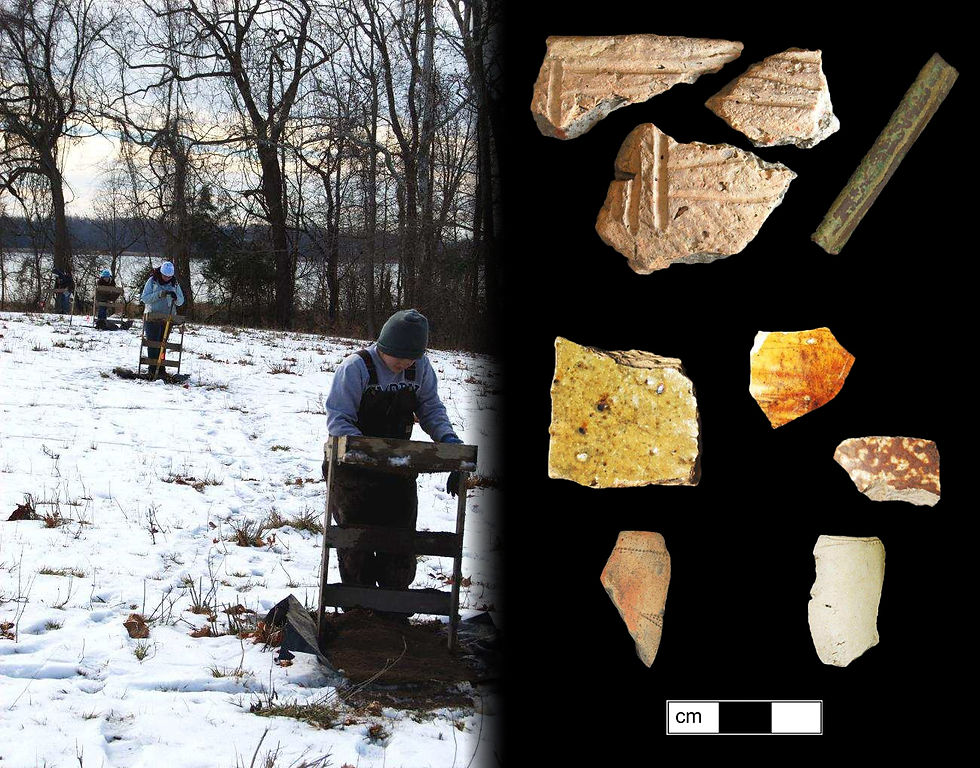
were confirmed – copper beads, indigenous and imported European ceramics, and locally made red clay and imported white clay tobacco pipes were the telltale signs (Figure 2).


Comments